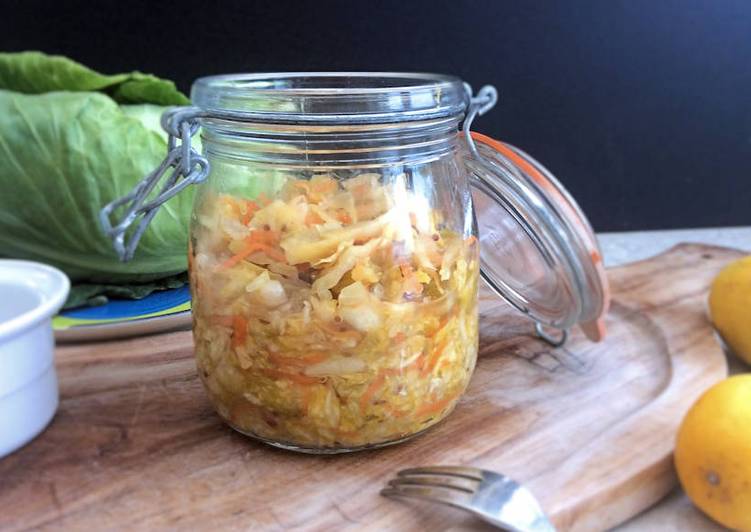
Hello everybody, I hope you’re having an incredible day today. Today, we’re going to make a distinctive dish, sauerkraut. It is one of my favorites food recipes. This time, I’m gonna make it a little bit tasty. This will be really delicious.
In an extra-large bowl, combine salt and cabbage. I can make organic sauerkraut for much less than that. And the process of making sauerkraut is quite simple, so the work involved doesn't mitigate the savings.
Sauerkraut is one of the most popular of current trending meals in the world. It’s simple, it is quick, it tastes yummy. It is appreciated by millions daily. They’re fine and they look wonderful. Sauerkraut is something that I have loved my entire life.
To get started with this particular recipe, we have to prepare a few components. You can have sauerkraut using 8 ingredients and 7 steps. Here is how you cook that.
The ingredients needed to make Sauerkraut:
- Make ready 1 head spring cabbage, about 450-500g when shredded
- Prepare 1 medium carrot
- Make ready 3 garlic cloves, peeled and roughly chopped
- Make ready 10 g good quality sea salt
- Make ready 1 dried chili, deseeded and snipped into little pieces with scissors
- Take 1 tsp caraway seeds
- Make ready 1 tsp black mustard seeds
- Get 1/2 tsp fennel seeds
Sauerkraut is a traditional dish of fermented vegetables. Learn how to make your own sauerkraut with this simple how-to from Food Network. A tasty side dish of sauerkraut is mellowed and sweetened by onion, brown sugar, and sherry. Weighting and Pressing Kraut in a Crock.
Steps to make Sauerkraut:
- This amount of cabbage makes less than one 1 litre jar, kilner or an ordinary jar with a well-fitting lid.
- Shred the cabbage quite finely, discarding any blemished outer leaves but save one. Julienne or coarsely grate the carrot.
- Place the vegetables with the garlic in a large bowl, add the salt and rub it into the cabbage with your hands for a couple of minutes. Cover the bowl with a clean cloth and leave for a few hours, up to overnight.
- Rinse the jar with boiling water. Add the spices and chili and toss them through the cabbage with your hands. Put the cabbage into the jar in four or five goes, packing it tightly in with a handle of a wooden spoon or a meat mallet. Pour any left juices over the top.
- Rinse the spare leaf and press it into the jar on top of the cabbage – ideally there should be enough juice to cover it, the leaf is there to keep it immersed. Weigh the leaf down with a clean large pebble, a cup or a small bowl, anything that will fit into the jar. Leave it open but cover with a piece of muslin or a clean cloth.
- After 24 hours check if the cabbage has not floated to the top, press it down again with the wooden spoon to get rid of any trapped air, recover with the leaf, bowl and the cloth and keep it in a cool, darkish spot. The fermenting will take between 1 – 3 weeks, depending on the season and the temperatures.
- After a week start tasting the sauerkraut. When it’s sour and tart enough for you, discard the leaf, close the jar with the lid and keep the sauerkraut in the fridge.
Place shredded cabbage and salt in a large fermentation crock or bowl. Instead of pounding, weigh the cabbage down with heavy bowls or pebbles. Press on the weights regularly to draw the natural juices out of the cabbage and submerge the cabbage slowly in the brine. Sauerkraut is a popular side-dish and condiment, and it is especially famous in Germany. In fact, sauerkraut is a German word which translates as "sour cabbage." Despite common belief, the origins of sauerkraut lie outside of Europe, and it appears to have originated in China.
So that’s going to wrap this up with this exceptional food sauerkraut recipe. Thanks so much for your time. I am confident you will make this at home. There is gonna be more interesting food in home recipes coming up. Don’t forget to save this page on your browser, and share it to your loved ones, colleague and friends. Thank you for reading. Go on get cooking!